Have you ever wondered why certain graphic tees look brand new after years of heavy use while other designs fade away after just one single wash? That distinct difference almost always comes down to the actual production method utilized at the factory. For local businesses, Omaha screen printing shirts remains the undisputed champion when it comes to promoting your brand.
In this guide, you will learn exactly how the screen printing shirts process works, why the ink sits perfectly on top of the fabric rather than soaking in, and exactly what makes it the go-to choice across multiple commercial industries.
What Makes Screen Printing Shirts the Industry Standard?
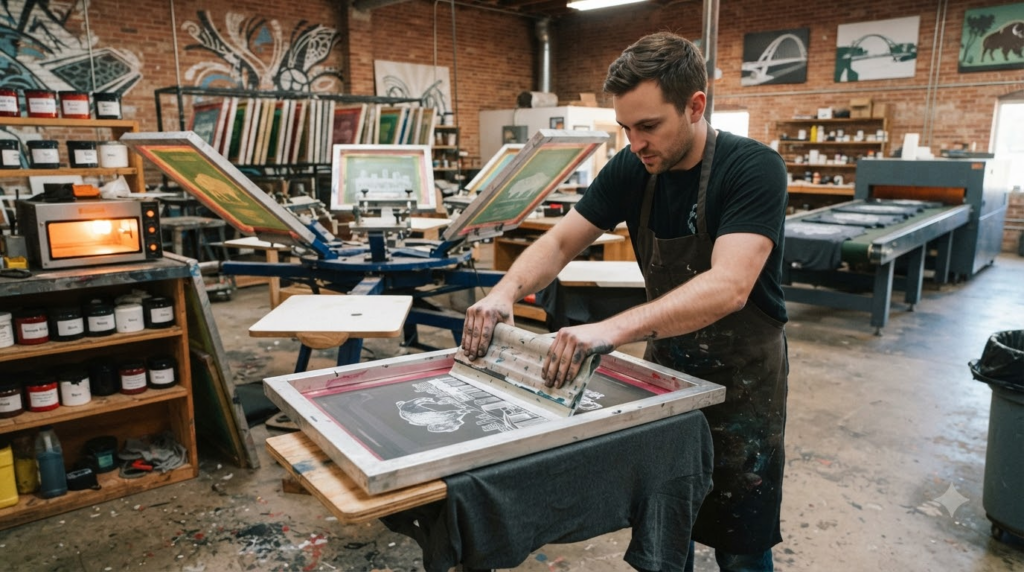
People often wonder why a century-old printing technique still dominates the modern apparel landscape. The answer lies directly in the actual behavior of the ink. Traditional dye-based methods soak completely into the fabric fibers, which can result in muted tones — especially on darker garments. Screen printing shirts rely heavily on plastisol ink, which stands as the absolute industry standard for apparel decoration. Plastisol pushes through a stenciled mesh screen and sits squarely on top of the fabric surface as a physical layer. That specific physical buildup creates a raised, tactile texture that instantly communicates premium quality to anyone wearing the garment.
Colors stay incredibly vibrant precisely because the ink does not absorb into the material below. Properly curing the ink using a flash dryer or heat tunnel bonds it firmly to the garment fibers. That heat-cured bond fiercely resists fading, cracking, and peeling through hundreds of laundry cycles. You get a highly durable product that simply outlasts thinner, dye-based printing alternatives over repeated use.
The Core Mechanics Behind the Method
Every single color in a graphic design requires its very own dedicated screen. Creating a vivid three-color corporate logo requires three separate screens — all perfectly aligned before any ink touches the fabric. Printers call that precise alignment process “registration,” and getting it wrong instantly produces blurry edges and ugly color overlap.
Each color demands separate setup time, which directly affects your final production cost. Single-color prints are significantly cheaper than complex six-color designs purely because screen setup remains the main fixed cost of the entire operation. Screen printing excels at bold graphics featuring strictly defined colors and razor-sharp edges. Photographic images and heavy gradients require complex halftone simulations — adding screens and unwanted complexity — making them less ideal for the standard screen method.
Beyond T-Shirts: Expanding Your Custom Apparel
Textile decoration stretches far beyond the basic cotton tee. Creating custom shirts Omaha is a massive part of the industry, but the exact same mesh-and-ink process applies to diverse materials across the board. The fundamental process remains identical whether you are printing a limited-edition streetwear drop or a massive fleet of corporate uniforms.
- Heavyweight garments: Designing a custom hoodie requires thick, opaque inks that stand out brilliantly against dark fleece materials.
- Corporate branding: Organizations routinely order branded tote bags, conference notebooks, and event merchandise because the technique maintains consistent coloring across thousands of units.
- Specialty items: Many people are surprised to learn that outdoor banners, decals, sports gear, and even the branding on glass bottles regularly utilize screen printing.
Omaha Polo Embroidery: A Viable Alternative That Exudes Professionalism
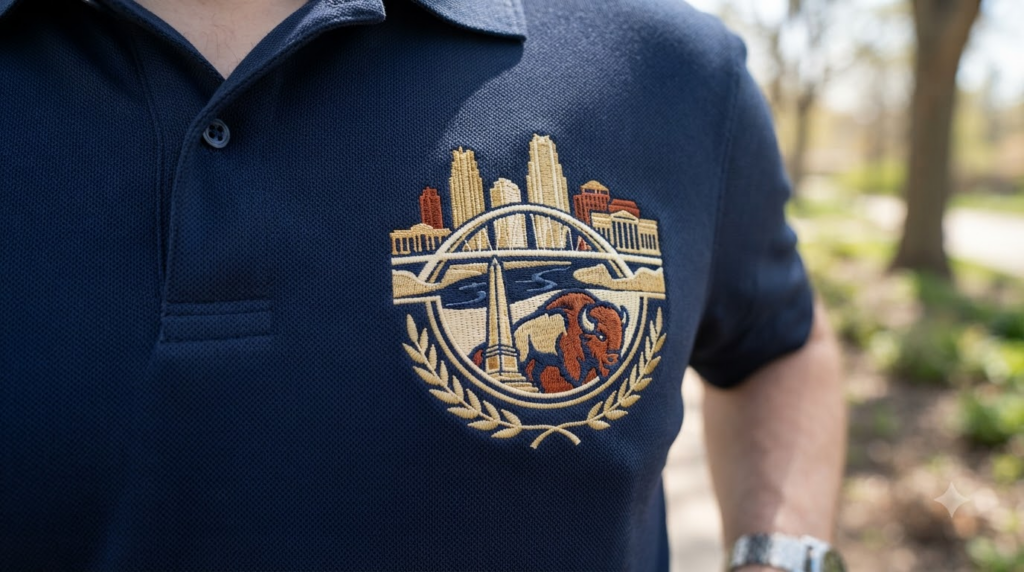
Companies needing highly professional office attire might pivot toward uniform embroidery services. A heavy stitched logo looks absolutely incredible on a quarter-zip jacket. Adding Omaha polo embroidery to your corporate wardrobe brings a dimension of texture that flat ink cannot easily replicate.
Omaha businesses often combine screen-printed casual wear with embroidered executive wear to build a beautiful, cohesive uniform package.
When to Choose Screen Printing: Common Case Scenarios
Picking the right t-shirt printing method saves you money and guarantees a vastly superior final product. Screen printing acts as the most economical method available assuming you hit the right manufacturing criteria.
Here are the exact scenarios where pushing ink through a mesh screen makes the most logical sense:
- The graphic features one to six solid, bold colors.
- Durability acts as a major priority because the garment will face heavy daily use.
- You demand vibrant, opaque colors on dark or brightly colored fabrics.
- You need to lower the per-unit cost on a high-volume order.
Did You Know: Print-on-demand services, mixed-fabric orders, and photographic designs also pair much better with alternative printing solutions rather than traditional screens.
A Quick Look at the Screen Printing Shirts Process
Understanding the actual mechanical steps helps you communicate better with your local print shop and catch potential design problems early. The entire operation follows a strict six-stage workflow.
First, the design separates into color layers printed onto transparent film. Second, a mesh screen receives a smooth, even coat of photosensitive emulsion using a scoop coater. Exposing the coated screen under UV light hardens the emulsion everywhere except where the dark film strictly blocks the light.
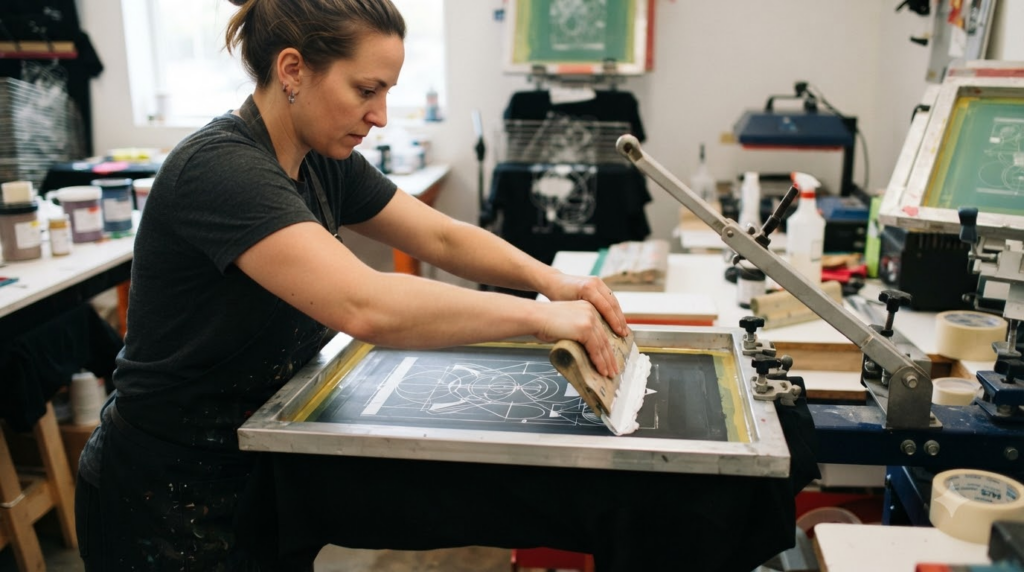
Washing the exposed screen with water removes the soft, unexposed emulsion to leave an open mesh stencil. A squeegee then pulls ink firmly across the mesh at a consistent 45-to-75-degree angle to force rich color onto the fabric below. The garment travels through a heat tunnel afterward to fully cure the ink into a solid, highly durable state.
Preparing Your Artwork for the Best Print Results
Submitting the correct file type is the single most important step before manufacturing begins. Many people mistakenly send low-resolution images taken directly from a social media page. Such files produce pixelated, jagged edges on the final product. You must always provide your printer with crisp vector files — such as an Adobe Illustrator (.AI) or .EPS document. Vector graphics scale infinitely without losing any quality.
Submitting clean vector art prevents costly production delays and absolutely guarantees that your Omaha screen printing shirts feature the sharpest possible lines. Utilizing the high-quality screen printing Omaha relies on starts right at the digital design phase.
Key Takeaways
- Omaha screen printing shirts remain a popular choice for businesses because they deliver vibrant colors, strong durability, and a professional finish that lasts through repeated washing.
- Screen printing uses plastisol ink that sits on top of the fabric, creating a raised texture and helping designs resist fading, cracking, and peeling over time.
- The screen printing process requires separate screens for each color, making it most cost-effective for bold designs, simple graphics, and large-volume apparel orders.
- Custom apparel options extend beyond t-shirts, including hoodies, uniforms, tote bags, promotional products, sportswear, and specialty items.
- Omaha polo embroidery offers a professional alternative for corporate clothing, adding texture and a premium stitched appearance to branded garments.
- Preparing high-quality vector artwork before printing helps achieve sharper designs, accurate colors, and better results for custom apparel projects.
Conclusion
Investing in high-quality apparel requires choosing a production method that truly lasts the test of time. Screen printing earns its reputation as it delivers unparalleled color vibrancy and structural durability that other techniques simply cannot match at scale. Knowing fabric preference and design complexity makes deciding on a production method incredibly straightforward.
Omaha Print Shop specializes in creating premium Omaha screen printing shirts for local businesses. We deliver durable custom apparel that represents your brand accurately and professionally and aligns with your promotional and marketing goals.
Reach out to Omaha Print Shop today to turn your next creative apparel concept into a stunning wearable reality.
Frequently Asked Questions (FAQs)
How long does it take to receive an order of Omaha screen printing shirts?
Standard production timelines typically range between seven and fourteen business days following final artwork approval, although many local print shops provide expedited rush services to accommodate strict event deadlines.
Can I print a photograph using standard screen printing?
Photographs require highly complex halftone simulations, making digital direct-to-garment printing a much better option than utilizing traditional screens.
Why does the ink on my custom shirt feel slightly raised?
Plastisol ink sits directly on top of the fabric fibers instead of soaking in, creating a slightly raised, tactile texture that communicates premium quality.
How do I stop my screen printed graphics from cracking?
Proper heat curing at the printing facility prevents cracking, while washing garments inside out in cold water extends their overall lifespan significantly.
Are uniform embroidery services better than screen printing?
Embroidery provides a highly textured, professional finish ideal for corporate polos and jackets, while screen printing works best for bold, large-scale t-shirt graphics.